
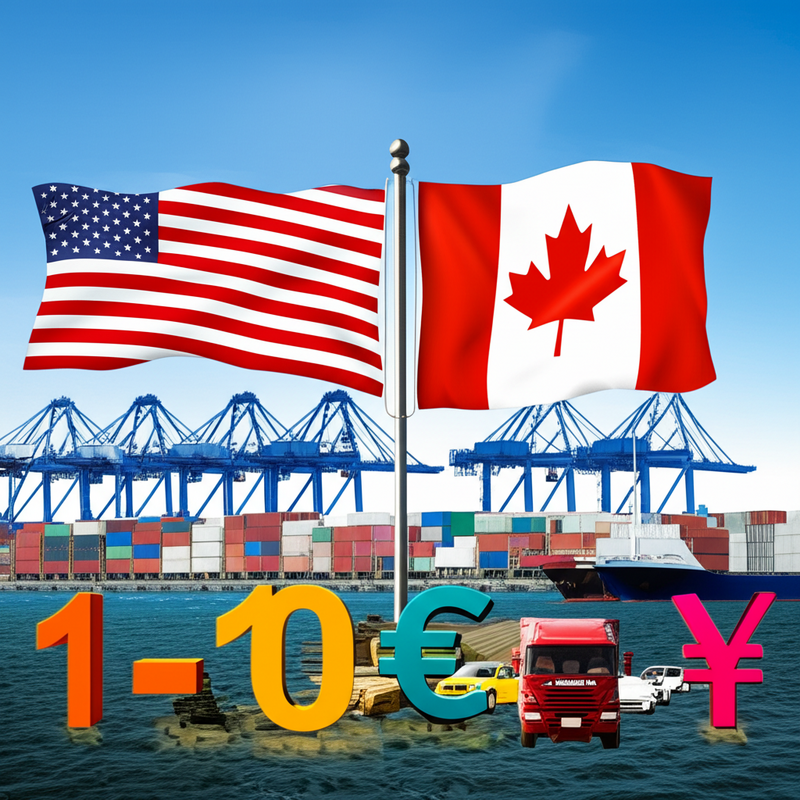
Trump Hikes Tariffs on Canada: A New Chapter in Trade Tensions 📈🇨🇦
In a move as unexpected as a blizzard in July, President Trump’s administration has announced a fresh hike of 10% in tariffs on Canadian goods. This decision, which echoes the tumultuous trade war of previous years, comes in response to an ad campaign from Ontario promoting an anti-tariff narrative. It’s almost as if President Trump has taken Canada’s marketing audacity as a personal affront— d’une façon aussi inattendue que descubrir que el chocolate es un ingrediente de la pizza.
The irony of this latest escalation lies in the fact that the United States and Canada, traditional allies, are now at the center of an economic tussle that seems to unfold like a poorly scripted soap opera. From a nation founded on shared values and economic collaboration, we now find ourselves starkly juxtaposed against a backdrop of escalating tariffs and strategic maneuvering. Caught in the crossfire are consumers, businesses, and growth prospects— a triangular relationship as fragile as a spider’s web shaken by a sudden gust of wind.
Tariff Hikes: What It Means For Trade Relations
The 10% increase brings the already complex trade relationship between the two countries to new heights—or perhaps, depths—depending on how one perceives the economic landscape. The question arises: will these tariffs forge a path to American manufacturing’s revival, or will they inadvertently tighten the noose around the necks of American consumers, who rely on imported goods at prices that now snap like a rubber band pulled too taut? 🤔
In the first half of 2023, trade between the United States and Canada represented over $600 billion, a testament to the interconnectedness of these economies. This new tariff hike disrupts the delicate balance, like a gust of wind toppling a house of cards. Economists warn that such bold moves lead to retaliatory measures, reinforcing the notion that trade wars often yield a lose-lose situation: when one country escalates, the other retaliates, and the cycle spirals downward.
The Canadian Response: A Quiet Storm
In response to this tariff hike, Canadian officials have expressed outrage, hinting at potential retaliatory tariffs that could create a cascade of repercussions. It is as though they’ve been handed a pair of boxing gloves at a polite dinner party, their fists clenching in disbelief and determination. Canada’s finance minister has stated that the government will explore all options available, a stance that suggests a brewing conflict much like storm clouds looming over a calm lake.
As regional industries, particularly those reliant on timber, agriculture, and automotive sectors, brace for impact, one can’t help but wonder whether the Ontario government’s strategy of public messaging will backfire. The anti-tariff ad, which spurred this hike, may now serve as an unintended catalyst igniting a trade squabble that hampers both economies—an irony wrapped in a riddle, served on a platter of unintended consequences.
Implications for Consumers and Businesses
Consumers are set to feel the ramifications almost immediately. Increased costs on everyday goods could turn shopping from a casual experience into a strategic expedition, making wallet injuries more pronounced than ever. Picture standing in line at your local grocery store, watching as a carton of milk transforms into a luxury item, akin to gold bars in a pirate’s treasure chest—a perplexing invitation to ponder the price of a latte amidst the chaos. 🥛
For American businesses, those relying on Canadian imports for their supply chains face similar existential questions. Higher costs could erode profitability quicker than ice cream on a summer day, leaving enterprises scrambling to adjust pricing or find alternative suppliers. The potential fallout is enough to make even seasoned economists break a sweat, leading many to ask: will there be any winners in this trade saga, or is victory just an illusive concept?
A Market in Flux: The Broader Economic Picture
Looking beyond this immediate tariff hike, one has to consider how this plays into the larger economic landscape, where geopolitical tensions simmer beneath the surface, often serving as an unseen hand. The United States is attempting to retool its industrial strategy amidst an interconnected global economy—often described as a double-edged sword, cutting both ways with potential risks and rewards.
The irony is palpable: as Trump’s administration insists on revitalizing American jobs, they may unintentionally drive businesses toward offshoring instead. Increased tariffs could compel manufacturers to look for cheaper alternatives abroad, an outcome that would circle back to the very issue at hand: job creation at home. Indeed, the quest for economic self-sufficiency can sometimes feel like chasing the horizon—always just a bit further away.
With inflation already teetering on the edge, economists warn that such tariffs could fuel further price increases, an unwelcome scenario for an American public still reeling from economic disruptions. Consider, then, the juxtaposition of effort and outcome, where the aim to protect domestic interests may end up tightening the noose on everyday Americans—an outcome fitting for a cautionary tale.
The Final Word: A Rocky Road Ahead
So where does this leave us? With the potential for a trade conflict simmering just beneath the surface, it appears that the U.S.-Canada relationship is headed for a rocky road ahead. The latest tariff hike, like a sudden storm, brings uncertainty and volatility, fueling fears about the future economic landscape. The complexities of producing goods, pricing, and consumer purchasing can seem like a tangled web, each strand affected by the interplay of government decisions and market realities.
As the adage goes, “what goes around, comes around.” For both nations, this latest round of tariffs may simply serve as the start of a prolonged cycle of tension, backlash, and economic reconsiderations—one that reminds us all that trade is as much about people and relationships as it is about numbers on a spreadsheet. The stakes are high, and the dialogue is increasingly pressing. What comes next may very well shape not only trade dynamics but also the socioeconomic fabric binding together two nations historically tied through commerce and cooperation. 🌎