
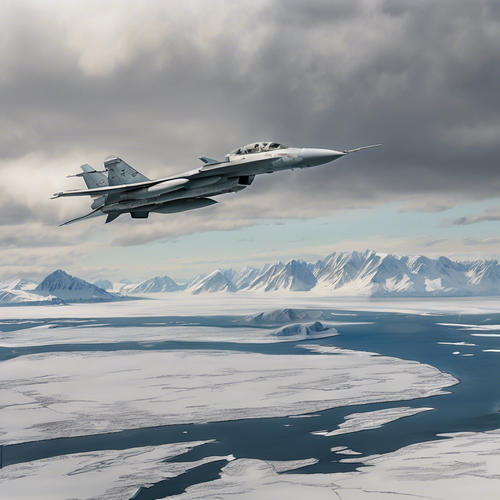
Russian Aircraft Spotted Near Alaska: A Tense Reminder of Cold War Echoes ✈️🌍
In a scene reminiscent of the shadowy maneuvers of a bygone era, Russian military aircraft have once again fluttered onto the radar near Alaska. NORAD (North American Aerospace Defense Command) confirmed this curious intrusion, reminding many of a time when every fleeting shadow over the Arctic skies carried whispers of tension and dread. Why does history seem to repeat itself, like an old vinyl record skipping back to its most jittery tune? 🔄
On this occasion, the aircraft spotted were strategic bombers, flying not quite as stealthily as one might hope, for their timing coincides with a period of heightened geopolitical tension. Not so very long ago, we would have been greeted by ticker-tape headlines and fevered speculation. But today, in the age of smartphones and instant communication, the news arrives like a cold breeze gusting through a broken window: sharp, swift, and laced with perhaps too much familiarity.
Echoes from the Cold War
The sighting invites reflection on the phrase “The Cold War never really ended”—that paradoxical sentiment suggesting the duality of peace and conflict, ever in a delicate dance. The aircraft traversing the ocean echo the phantoms of the Cold War, a reminder that while the global stage has shifted, many scripts remain unchanged. The intense posturing and ominous flybys that characterized the confrontations between the U.S. and the Soviet Union now finds new life in altered costumes.
It’s intriguing to recognize that, according to the Pentagon, Russian aircraft visit this part of the world far more frequently now than even at the height of those frigid tensions. In a sense, the world’s superpowers are engaged in a game of cat-and-mouse, continually testing each other’s boundaries while simultaneously broadcasting reassurances that all is calm. That’s irony in action: the nations who once froze each other out are now simply taking turns sharing the slightly warmer air. 😏
The Implications for U.S. Defense Strategy
From a national security perspective, these overflights pose a challenge that is as much about vigilance as it is about strategy. As Russian aircraft skirt the boundaries of Alaska, they’re not just appearing; they serve a dual purpose—to gather intelligence and test responses. For U.S. defense officials, these incursions are an unsettling reminder of the precarious nature of Arctic sovereignty, a region increasingly in the spotlight for both resource exploration and military strategy. 🛰️
The vastness of the Arctic is enticing much like a banana split set tantalizingly atop a sundae bar; the potential for new resources beckons global powers, making aerial surveillance a paradoxical necessity. While the Arctic remains a stark expanse, it has now been painted with geopolitical significance, drawing nations into a high-stakes game where the air and ice become the board and pieces simultaneously.
Geopolitical Chess and the Arctic Strategy
The reality is that a robust U.S. defense strategy must remain flexible enough to address these provocations while also keeping an eye on the broader implications for Arctic policy. For years, Russian bomber operations have been growing, resembling a subtle assertion of ownership over airspace that some may argue has swelled with a sense of entitlement, much like autumn leaves falling softly but insistently onto a still surface of water.
- Increased Military Presence: The U.S. and its allies are ramping up their operations in response, conducting joint military exercises in the region.
- Sophistication of Surveillance: Enhanced surveillance technology is being refined to ensure timely detection of aerial incursions.
- Activating International Agreements: With nations eyeing Arctic potential, international treaties regarding airspace and maritime routes are becoming increasingly relevant.
Reconciling Old Rivalries with New Realities
These aerial encounters sublimate more than just historical rivalries—they encapsulate the nuances of our evolving world. As nations maneuver amidst vast and changing landscapes, we find ourselves grappling with the same questions that plagued diplomats of the past. How should nations respond to intrusions, and how do we create a sustainable balance between military preparedness and the search for diplomatic solutions? 🤔
Those poignant moments of tension beg one to ask: Is this a resurgence of Cold War fears or merely a reflection of the new realities of international relations? As the banners of both sides flutter in the winds of the Arctic, an unsettling truth remains—what was once a mere diplomatic conversation now dances along the thin line where provocation meets obligation. ⚖️
Perhaps, as we traverse the rugged terrain of modern diplomacy, we are left to reconcile our past perceptions with a future that remains inherently unpredictable. In the stark shadows of these aircraft, an understanding looms: the engaging dance of political maneuvering extends far beyond the realm of military tactics; it captures the essence of human connection, deterrence, and the perennial quest for peace amid turbulence.
Though these Russian aircraft might be primitive players in the grand geopolitical chess game, they serve to remind us that the game itself is anything but static. As we watch the battle for air and influence unfold in the Arctic, the question for policymakers remains: Are we equipped to navigate these icy waters, not merely with weaponry, but with wisdom carefully crafted for a hopeful future? 🧭🔍