
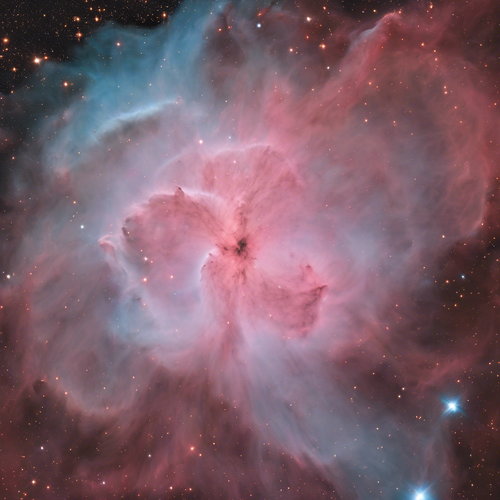
Unveiling the Mysteries of the Cosmos: The Cotton Candy Nebula as Captured by the World’s Largest Telescope
In a spectacular achievement for astronomical observation, scientists have unveiled the first close-up view of the mesmerizing Cotton Candy Nebula, a colorful cloud of gas and dust located in the heart of the universe. This breathtaking image, taken by the world’s largest cosmic telescope, has not only captured the imagination of space enthusiasts but also provided extraordinary insights into the life cycle of stars. 🌌✨
The Cotton Candy Nebula: A Cosmic Wonder
The Cotton Candy Nebula, known officially as LBN 762, is a vibrant showcase of stellar phenomena, reminiscent of spun sugar in its delicate pinks, blues, and purples. Lying approximately 800 light-years away in the constellation of Cassiopeia, this nebula has been forming over millions of years as stars are born, evolve, and eventually die, leaving behind traces of their cosmic journey.
Thanks to the advanced technology of the James Webb Space Telescope (JWST), astronomers were able to penetrate the veil of dust and gas that obscures many celestial objects. The JWST’s infrared capabilities are designed to capture these previously hidden features, allowing us to observe the universe in a way never before possible.
Visualizing Stellar Life Cycles
This vivid representation of the Cotton Candy Nebula reveals multiple star-forming regions, which appear as bright knots nestled amid the dimmer background. It is in these areas that gravity pulls gas and dust together, igniting the birth of new stars 💫. Such observations are crucial for understanding the life cycle of stars, emphasizing how each nebula acts as a nursery for future stellar bodies.
“The Cotton Candy Nebula is more than just a stunning visual; it’s a reminder of the ongoing dance of creation and destruction that defines our universe,” states Dr. Elena Martinez, a leading astrophysicist involved in the research.
Technological Marvel: The James Webb Space Telescope
The JWST has revolutionized our understanding of cosmic phenomena. As the most powerful space telescope ever built, it is equipped with a suite of scientific instruments that allow it to observe the universe in infrared light. This capability is essential for studying phenomena that are too faint or too cool to be detected in visible light, unearthing not only celestial bodies but also the intricate structures that surround them.
Its 6.5-meter mirror collects more light than its predecessors, enabling higher resolution images and deeper observations. This leap in technology opens new frontiers in astronomy, allowing researchers to explore distant galaxies, star clusters, and nebulae with astonishing clarity 🛰️.
The Significance of the Cotton Candy Nebula’s Discovery
The importance of the Cotton Candy Nebula transcends its visual appeal. The data harvested from its observation offers critical insights into the physical processes that govern star formation. Understanding these processes not only informs our knowledge of our galaxy but also the cosmological evolution of the universe as a whole.
Future Explorations: What Lies Beyond? 🌠
With each new discovery made possible by advanced telescopes like the JWST, astronomers are opening a window into the past, present, and future of our universe. Future missions aim to delve deeper into the mysteries of nebulae, exploring how these celestial phenomena influence star populations and galactic formation.
As we continue to refine our technology and expand our reach into the cosmos, who knows what other wonders await us? Perhaps, with each click of a shutter in the vast expanse of space, we are not merely capturing images, but unraveling the very fabric of existence itself. 🔭