
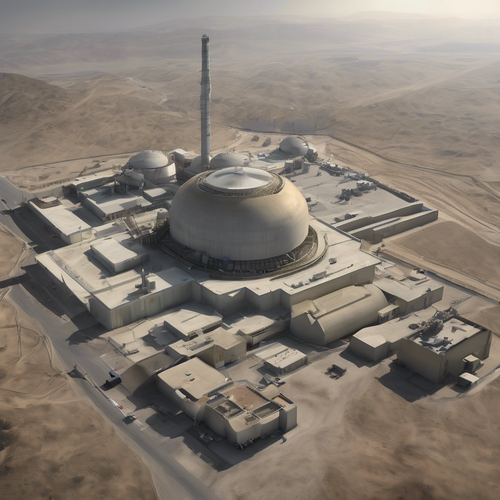
Israel’s Strategic Silence: Why the Fordo Nuclear Facility Remains Unscathed
As tensions continue to simmer in the ever-turbulent waters of Middle Eastern politics, all eyes have turned toward Iran’s Fordo nuclear facility—an underground stronghold shrouded in secrecy and fortified against potential strikes. Although Israel has repeatedly threatened military action to thwart Iran’s nuclear ambitions, the ongoing silence regarding direct strikes on Fordo invites deeper scrutiny. Why hasn’t Israel acted decisively? The answers intertwine military strategy, geopolitical calculus, and potential repercussions that could govern the course of regional stability and global security. 🌍
The Enigma of Fordo: A Nuclear Stronghold
Nestled deep within the mountains near Qom, Iran’s Fordo facility has become a focal point of international concern since its discovery in 2009. Designed to enrich uranium to levels potentially suitable for nuclear weaponry, this fortified site is protected by heavy security and advanced technology. According to estimates, a military strike needs to overcome enhanced defensive systems, including anti-aircraft batteries and hardened structures capable of withstanding direct hits. Notably, the facility is strategically significant—not only for Iran’s nuclear ambitions but also for its role in the broader conflict with Israel and the West. 🤔
Israel’s Strategic Calculus: Risks vs. Rewards
Israel’s hesitance to engage militarily against Fordo can be viewed through the lens of a multi-faceted risk assessment:
- Potential Fallout: Strikes against Fordo could unleash a retaliatory response from Iran, which has vowed to protect its nuclear program at all costs. Such retaliation could include missile strikes on Israeli cities or mobilization of proxy forces in the region. The prospect of an escalated conflict looms large and could destabilize an already volatile region. ⚖️
- International Repercussions: Military action against an entrenched nuclear facility could provoke global condemnation. The potential fallout could lead to sanctions or increased diplomatic isolation for Israel, much to the advantage of its adversaries.
- Effectiveness of Military Strikes: Analysts question whether Israel’s airstrikes could effectively incapacitate Fordo’s operations. Given its subterranean design, experts argue that even a successful strike may only temporarily disrupt Iran’s nuclear program, allowing for rapid recovery in the years to follow. 🔄
Intelligence and Cyber Capabilities: The Invisible War
Amid the hum of military preparation, a quieter battle rages in cyberspace. Israel, leveraging its advanced cyber capabilities, has previously targeted Iranian nuclear facilities through digital means rather than conventional warfare. The Stuxnet virus incident in 2010 stands as a prime example, successfully delaying Iran’s uranium enrichment through sophisticated sabotage. This approach represents a calculated shift, enabling Israel to undermine Iranian strength without the immediate risks associated with air strikes. 💻
Regional Allies and the Broader Context
Israel’s decisions regarding Iran’s nuclear ambitions cannot be evaluated in a vacuum. The shifting dynamics of regional alliances, particularly amid the normalization of relations with Arab nations, complicate the strategic landscape:
- Effective Coalitions: Opportunities for forming coalitions against Iran, notably with Gulf states concerned about Tehran’s ambitions, provide Israel with strategic allies. However, strikes against Iran could jeopardize these budding partnerships, fracturing a fragile but promising alliance. 🤝
- Changing U.S. Policies: As the Biden administration navigates its Iran policies, Israel must align its strategies within the broader U.S. framework. Military action would necessitate U.S. support, not only for intelligence and logistics but also for political backing on the international stage.
The Path Forward: A Tactical Game of Chess
The stakes are high, and the consequences daunting. Israel’s apparent inaction against Fordo suggests a deeply strategic game of chess rather than a straightforward military dilemma. As Israel recalibrates its approach, the question remains: how long before the balance tips? The intertwining of military, intelligence, and diplomatic strategies will define whether Fordo remains untouched or whether Israel opts for a decisive military strike in the future. Each calculated move could either pave the way toward stability or seal the fate of an escalating conflict in the Middle East. ♟️
“Israel operates on a principle of dual containment: a strong deterrent against Iran, but also a calculated restraint that acknowledges the complex realities on the ground,” notes Dr. Rebecca Sandler, an expert in Middle East geopolitical dynamics.
As the world watches, the pressure will only mount. The question remains whether Israel will ultimately decide that the risk of inaction outweighs the potential costs of military engagement. Only time will tell. ⏳