
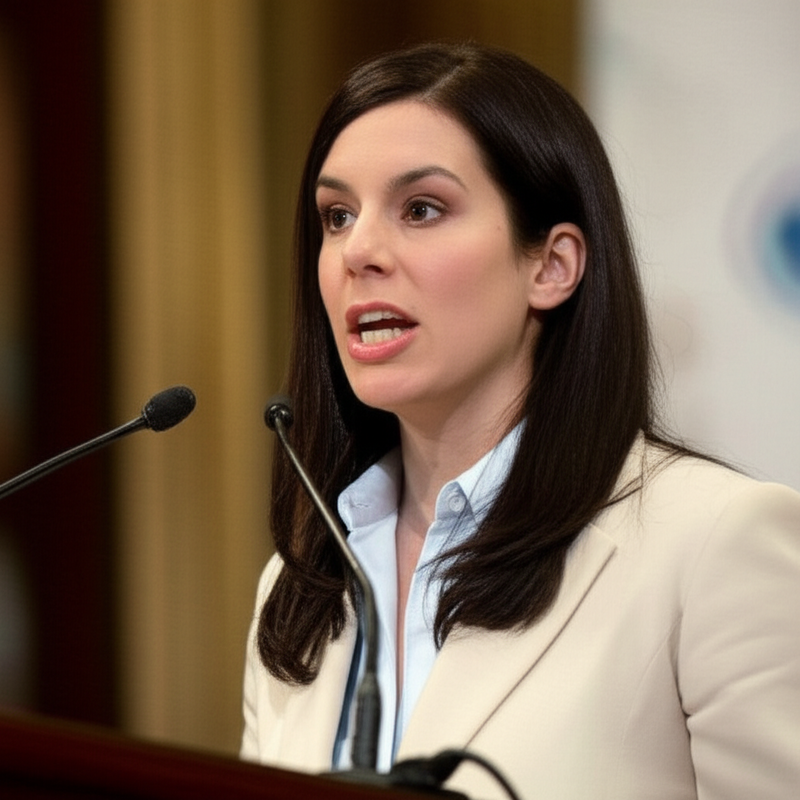
Read Venezuelan opposition leader María Corina Machado’s Nobel Prize speech, given by her daughter 🇻🇪🎙️
In an epoch where democracy in Venezuela flickers like a candle in a hurricane, the Nobel Prize emblem shined brightly on an unlikely stage – one that never saw the orator herself. María Corina Machado, an opposition leader condemned to silence within her own homeland, entrusted her daughter to deliver a speech that arises not merely from politics, but from the very marrow of human endurance. What happens when a voice meant to stir nations is relayed by family—the echo of a whispered rebellion amidst an iron curtain?
The Irony of Silence: When a Daughter Speaks for Her Mother
Imagine the striking paradox of a Nobel Peace Prize address delivered not by the laureate, but by her daughter. The dramatic irony is layered: a mother barred from crossing borders, her words carried across the seas by the most intimate of couriers. Their bond becomes the vessel of defiance—a symbolic simplification of what freedom can mean when it is forced to wear a mask.
This is not just a speech; it’s a testament. A statement delivered in a world that often applauds the laureate’s plight but conveniently forgets that the true struggle unfolds away from the spotlight, under the shadow of Nicolás Maduro’s hard fist. A regime that, somewhat ironically, flaunts its own legitimacy while strangling the democracy it claims to preserve. It’s the cruel comedy of autocracy, where freedom is reduced to whispers in exile.
Two Venezeulas: The Struggle and the Hope ⚔️✨
The antithesis is glaring as a desert rose blooming in an asphalt wasteland. On one side, there is Venezuela—once a beacon of oil wealth and democratic promise, now a somber monument to hyperinflation, shortages, and mass migration; a nation where hunger sharpens sharper than knives, and hope often seems like a once-forgotten melody. On the other hand, is the image invoked by Machado’s speech: a resilient citizenry clutching to dignity and democracy as if it were air itself.
Her daughter’s voice captured the evocative simile of a “river” — the unstoppable flow of freedom — that might be dammed but never entirely contained. The daughter invoked that potent metaphor to describe the Venezuelan people’s yearning for justice, navigating through the dark tunnels of repression, much like a river forging its way through cracks in rock.
“We are not simply victims; we are the architects of a new dawn,” the speech declared. In this, her message is a lantern in the oppressive dark; a steadfast reminder that tyranny trembles at the persistence of those willing to speak truth—even when their own voice is shackled.
The Nobel Committee’s Recognition: A Beacon or a Mirage? 🕯️
Granting a Nobel Prize to María Corina Machado proved a double-edged sword, threaded with subtle irony. Does an award enhance her power—or merely spotlight the regime’s cruelty in silencing her? The international accolade serves as both shield and sword: a shield protecting her narrative from oblivion, and a sword piercing the veil of state propaganda. Yet, there lies a cruel nuance; while the world watches and praises, everyday Venezuelans continue to suffer under suffocating economic collapse.
This contrast, this striking antithesis, fuels a broader question: how effective is symbolic recognition when the chains remain? It conjures memories of other laureates whose accolades couldn’t immediately topple regimes, but rather sowed the seeds for future change. In the theater of global politics, sometimes the applause rings hollow – the play is ongoing, the actors yet struggling to rewrite their scripts.
A Lived Experience Beyond Headlines
Meta reflections aside, beyond this high-profile speech and laureateship, Venezuelans face an abyss between international diplomacy and daily survival. In Caracas neighborhoods, empty shelves tell tales louder than any oratory. The fact that Machado’s voice had to be translated into the future through her daughter is an emblem of fractured realities—a political exile’s tale told through a mosaic of family bonds and distant hope.
I recall, once, in a café far from Caracas, meeting a young Venezuelan who described his homeland as “a garden choked with weeds”—cultivated once for everything, now strangled by neglect and tyranny. That image lingers because Machado’s speech, too, was a call to clear those weeds—no longer with violence, but with the steadfast insistence that freedom, like wild grass, will crack through any concrete.
The Universal Echo of a Venezuelan Plea
The Nobel speech, even given in absentia, transcends borders because its themes resonate universally: the fight against injustice, the courage to organize in the face of despotism, and the sheer human will to preserve dignity. Machado’s delivered message intersects with countless narratives worldwide — from the whispers of dissidents in distant autocracies to those who dare stand for democracy amidst modern-day darkness.
Her daughter’s rendition did not simply transmit words; it became a conduit sporting the electric charge of a family’s courage and an entire nation’s yearning. Does this not beg a wider reflection? How many other silenced voices traverse unwelcome paths, vectored through proxies, yet resonating with the unyielding heartbeat of human struggle? 🌍⏳
María Corina Machado’s Nobel moment unmasks the paradox of recognition and repression, hope and despair, past and future wrapped into a single, impassioned plea. It leaves us pondering: what is the price of freedom when it demands sacrifice not just of voice, but presence? And how will history remember that sometimes the loudest cries emerge from those who can only speak through shadows?