
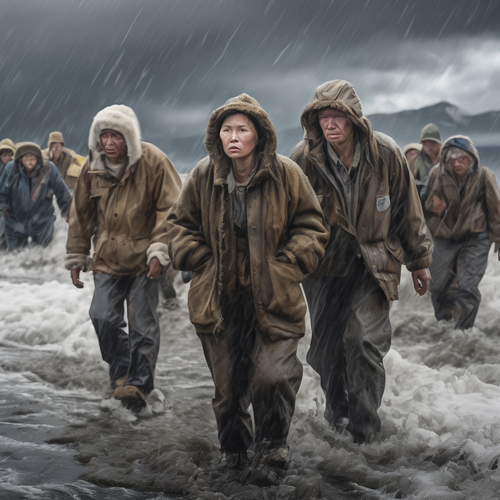
Surviving the Storm: Alaskan Evacuees Share Their Stories 🌪️🏔️
When the storm clouds gather over Alaska’s coastal communities, they do so not just with ominous warnings but with stories of foreboding. For many residents, these threats are all too real, forcing families to scramble for safety, often in the blink of an eye. As winds howl like a remorseful banshee—whipping through landscapes that have cradled generations—the journey to safety becomes a poignant testament to human resilience. “We’re all thankful that we’re all alive,” shared one evacuee, whose home was engulfed in chaos.
The Ironic Dance with Nature
In a state renowned for its breathtaking beauty, the stark irony resides in nature’s brutality. Alaskans have long coexisted with extreme elements—storms, blizzards, and earthquakes—yet each calamity feels like a harsh reminder of humanity’s tenuous grasp on control. An elderly fisherman, whose livelihood depends on the very waters now roiling violently, lamented, “I never imagined I’d be fleeing my own home while the ocean plays the villain.”
Stories of Escape: From Comfort to Chaos
The narratives emerging from these recent evacuations reveal a striking antithesis: moments of mundane daily life suddenly juxtaposed against the urgency of survival. One young mother recounted her frantic attempts to gather essentials: “It felt like a dream. One moment we were having breakfast; the next, I was stuffing all I could fit into a single backpack as if life could be contained in mere fabric.”
This vivid contrast—of everyday routines abruptly shattered—inhabits the hearts and minds of evacuees. In lieu of a leisurely cup of coffee, many found themselves racing against time, driven to leave cherished belongings behind. “I waved goodbye to my grandmother’s quilt,” another evacuee remarked quietly, “but that was trivial compared to the lives we saved.”
Communities Uniting in Crisis
The collective experience of evacuation transforms despair into determination, illuminating the noblest facets of humanity. In shelters, stories are swapped and laughter mingles with tears, reinforcing bonds woven over years. “It’s the tragic irony of life,” a local leader reflected. “In losing so much, we’ve found each other.” They form a fabric of solidarity, like threads pieced together after a storm rips through—in moments when the foundation seems most fragile.
As Alaska’s citizens gather in the aftermath, the spirit of community shines through as brightly as the northern lights. Some have chosen to shelter friends and family, turning homes into enclaves of hope against a backdrop of disaster. “I used to think homes were about the walls,” one woman mused, “but it’s the people within them that matter most.”
A Seasoned Navigational Course
The way forward is marked with uncertainty. Climate change poses an ever-growing threat to coastal communities, raising questions about their viability amidst a backdrop of increasing storms. One local historian succinctly captured this conundrum: “It’s as if we’re sailing into uncharted waters on a ship we built ourselves—brave but undeniably flawed.” The subtle implications are stark: an old way of life merging with new realities under the watchful eyes of fierce Arctic storms.
Looking Ahead: Resilience in the Face of Adversity
Among the wreckage left by nature’s wrath lies a determination to rebuild—physically and emotionally. “We learned that even in the darkest storms, gratitude can become our anchor,” an evacuee reflected, her tone imbued with both vulnerability and strength. “This community doesn’t just survive; we will rise, stronger.”
The evocation of natural phenomena in this context serves as a powerful reminder: much like the tides ebb and flow, so do fortunes and lives intertwine. As Alaskan evacuees chart the course toward recovery, their stories of loss become intertwined with those of hope, reminding us all that survival is not merely the absence of struggle, but the profound essence of human connection and resilience.
In the grand narrative of climate change and natural disaster, Alaskan evacuees serve as both witnesses and storytellers. They share the wisdom gleaned from fleeing the storm, a poignant juxtaposition of gratitude and grief, weaving together a resilience that seems as unsinkable as the mountains that guard their homeland.